
Too many to mention
I am interested in technology and I am interested in people. I have been fortunate enough to have my work (managing people in ICT environments) reflect my interests. I am interested in information technology, physics, space travel and orthomolecular medicine. I am also interested in psychology, neuroscience, religions, philosophy, nanotechnology, genetics and news.
Yes, I am a nerd.
“An Exceptionally Simple Theory of Everything”
Many scientist have been trying to unify quantum field theory and general relativity. So far the superstring theory seems to be the most popular attempt to achieve this. In november 2007 Garret Lisi published a new “Exceptionally Simple Theory of Everything” based on Lie groups (pure geometry) which looks very promising. For example unlike superstring theory it only needs 4 dimensions and unlike superstring theory (so far) it can probably be used to make verifyable predictions. This will perhaps allow actual verification of this theory in the future. E.g. mathematical physicist Peter Woit has used lack of testable predictions to argue against superstring theory.
Links related to this:
- An Exceptionally Simple Theory of Everything by Garret Lisi.
- Lie groups, E6, E7, E8.
- Not Even Wrong: The Failure of String Theory And the Search for Unity in Physical Law.
- Peter Woit’s response to Garret Lisi’s article.
- Slashdot comment explaining the E8 part.
A video explaining the theory:
Space Travel
Science fiction
Science fiction like Star Trek and Star Wars is probably the most exiting way of traveling through space:
Faster than a speeding Photon
Thought it might be a long while before we will actually travel faster than light, Chris Van Den Broeck (physicist over at the Catholic University in Leuven, Belgium) has developed a method to travel faster than light which might someday be used to travel across the galaxy. His article General Relativity and Quantum Cosmology is hard to read but explains exactly how it works. For more readable articles on this subject you might want to try Faster than light or Is Faster Than Light Travel or Communication Possible? The Office of High Energy and Nuclear Physics has an even more unconventional way of traveling through space. Read all about it in If you thought warp drive was weird, try jolt propulsion. All of this requires huge amounts of energy, a machine called Z might become the source.
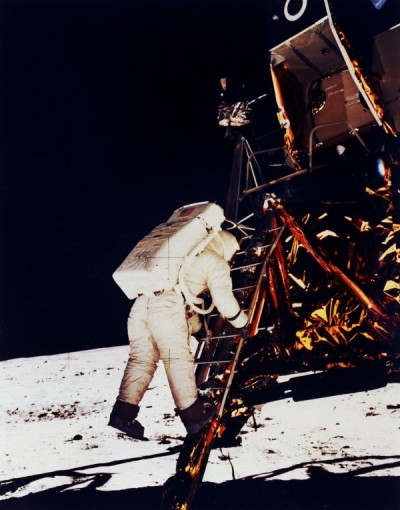
Man on the moon
Though a while ago, our trip to the moon is still our most impressive achievement:
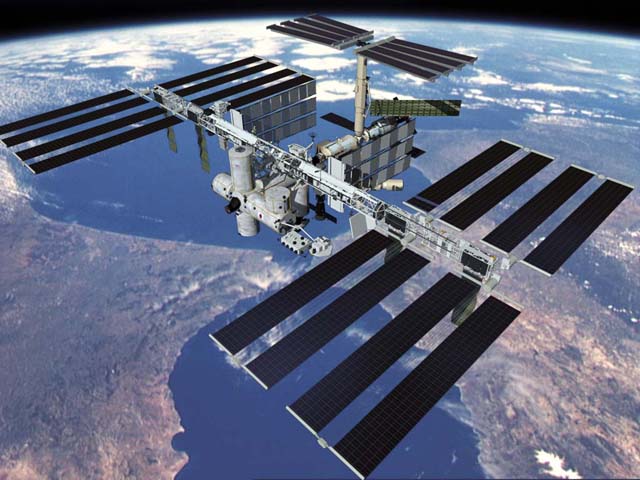
International Space Station
The International Space Station, which might someday be used as base for human exploration of Mars:
Orthomolecular Medicine
Orthomolecular Medicine describes the practice of preventing and treating disease by providing the body with optimal amounts of substances which are natural to the body. Or more simple: please make very sure you eat enough vitamins and minerals.
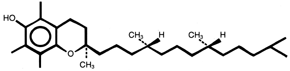
Some nutrition experts claim that the only way to get enough vitamins and minerals is to eat a well-balanced diet AND to eat supplements. E.g. vitamin E is an antioxidant which (in combination with other vitamins and minerals) slows down the aging process and reduces the chance of cancer, coronary heart disease and an array of degenerative diseases. Resveratrol has been proven to have cardioprotective and antidiabetic effects, although the exact effects are debatable. As is often the case with nutrition related science.
Vitamin E:
In the (far) future companies like Geron might develop methods based on Telomerase which not only reduce aging effects (like Vitamin E does) but will stop it altogether. Don’t expect this to happen anytime soon though. Companies like Geron also work on induced pluripotent stem cell technology which can be used to clone organs.
Other interesting links: The New England Journal of Medicine, The American Journal of Clinical Nutrition and The International Journal of Cancer.